
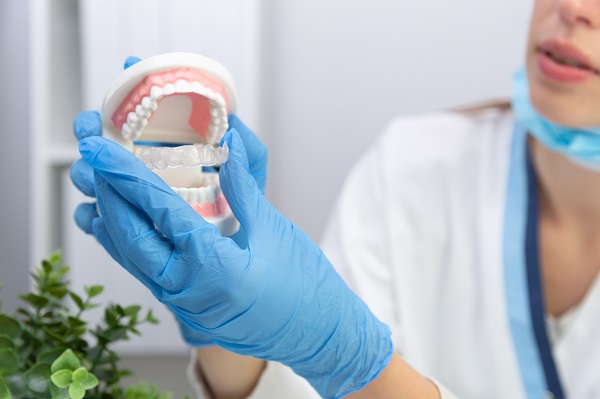
Orthodontics treatments involve the alteration of the teeth, the jaws, and the soft tissues that connect the two. These alterations can improve the alignment of said teeth and jaws. The resulting aesthetic and oral health benefits of orthodontic treatment are worth the time and effort of the process.
Moving different teeth to optimal positions requires a precision that comes with experience and innate skill. Reshaping a jaw to improve its form and function also takes skill and experience. So, can a general dentist administer orthodontics?
The different faces of orthodontics
The main way that dentists create a straight, pleasant smile is with the use of gentle, constant pressure. This pushes the teeth into optimal positions at a steady yet gradual pace. As the teeth shift, the jawbone breaks down and rebuilds itself to accommodate the movement of teeth roots. Dentists often prescribe specific orthodontic appliances, like braces, headgear, and jaw expanders, to realign the teeth and jaws.
Patients with severe orthodontic problems may need a more aggressive approach. Some may need a tooth extraction to correct overcrowding. Others may need corrective jaw surgery to treat severe jaw malformation. Still others may need the installation of a temporary dental implant to put pressure on specific teeth.
Orthodontics is a wide field that caters to patients with diverse needs. As such, dental professionals who provide orthodontic treatment need one or more skill sets. Some require surgical skills, while others need to be able to plot tooth and jawbone movements over the course of treatment.
Role of the general dentist in orthodontic treatment
A general dentist offers the first-line treatment and support. They offer preventative treatments, like routine checkups and teeth cleanings, to ensure good oral health. They can detect dental and oral problems in their early stages. In most cases, the general dentist will correct simple problems with restorative dentistry or with dental procedures, like root canals. The role of a general dentist as a first-line dental health provider also allows them to provide important orthodontic treatments.
1. Detection and monitoring
Regular checkups allow a dentist to spot problems in their early stages. A general dentist can detect an emergent bad bite that results from an accident or teeth grinding. In the case of children, a general dentist will monitor the growth of both their primary and permanent teeth. If the dentist detects a bad bite, they will keep tabs on the child’s teeth until the child is old enough for further treatment. For children and adults alike, a diagnosis for orthodontic problems should be the first step of treatment.
2. In-depth diagnosis
Diagnosis starts at the detection stage. It continues with medical imaging, a tool that allows the dentist to pinpoint the root cause of their patient’s orthodontic issue. An X-ray or a CAT scan will provide information that allows the dentist to chart a course of action.
3. First-line orthodontic treatment
Some patients require simple orthodontic treatments. A general dentist with the right training can oversee teeth straightening with braces. The dentist can also extract a tooth to correct crowding. They can recommend veneers or crowns for patients who need a smile upgrade.
Let our dentist chart your journey to an improved smile
A general dentist should be your first point of contact when you seek dental care. Our dentist will perform a comprehensive evaluation that will lay the groundwork for a healthy smile. If orthodontics is the ideal treatment, the dentist will walk with you through every step.
Request an appointment here: https://www.biancodentistry.com or call Dental Health Associates, PC at (503) 862-3270 for an appointment in our Portland office.
Check out what others are saying about our dental services on Yelp: Orthodontics in Portland, OR.
Related Posts
Implant Supported Dentures Guide: Process, Benefits, and Care
Implant-supported dentures offer a secure, long-lasting solution for those seeking enhanced comfort and function after tooth loss. Unlike traditional dentures, these restorations attach to dental implants that the dentist must anchor …
Proper Care Tips from an Invisalign® Dentist
Seeing an Invisalign® dentist is a popular way to straighten teeth without using metal braces. Many patients choose this treatment because it is clear, removable, and more comfortable than traditional braces. …
A Kid Friendly Dentist Explains the Importance of Brushing
Your kid friendly dentist understands how difficult it is to motivate kids to brush their teeth. Children often think of brushing as a tiring activity. Proper motivation can help them form …
Understanding the Process for Dental Bridges
Dental bridges are oral prosthetics designed to bridge the gap left behind by a missing tooth. Their primary aim is to restore the appearance and function of a smile. Partnering with …